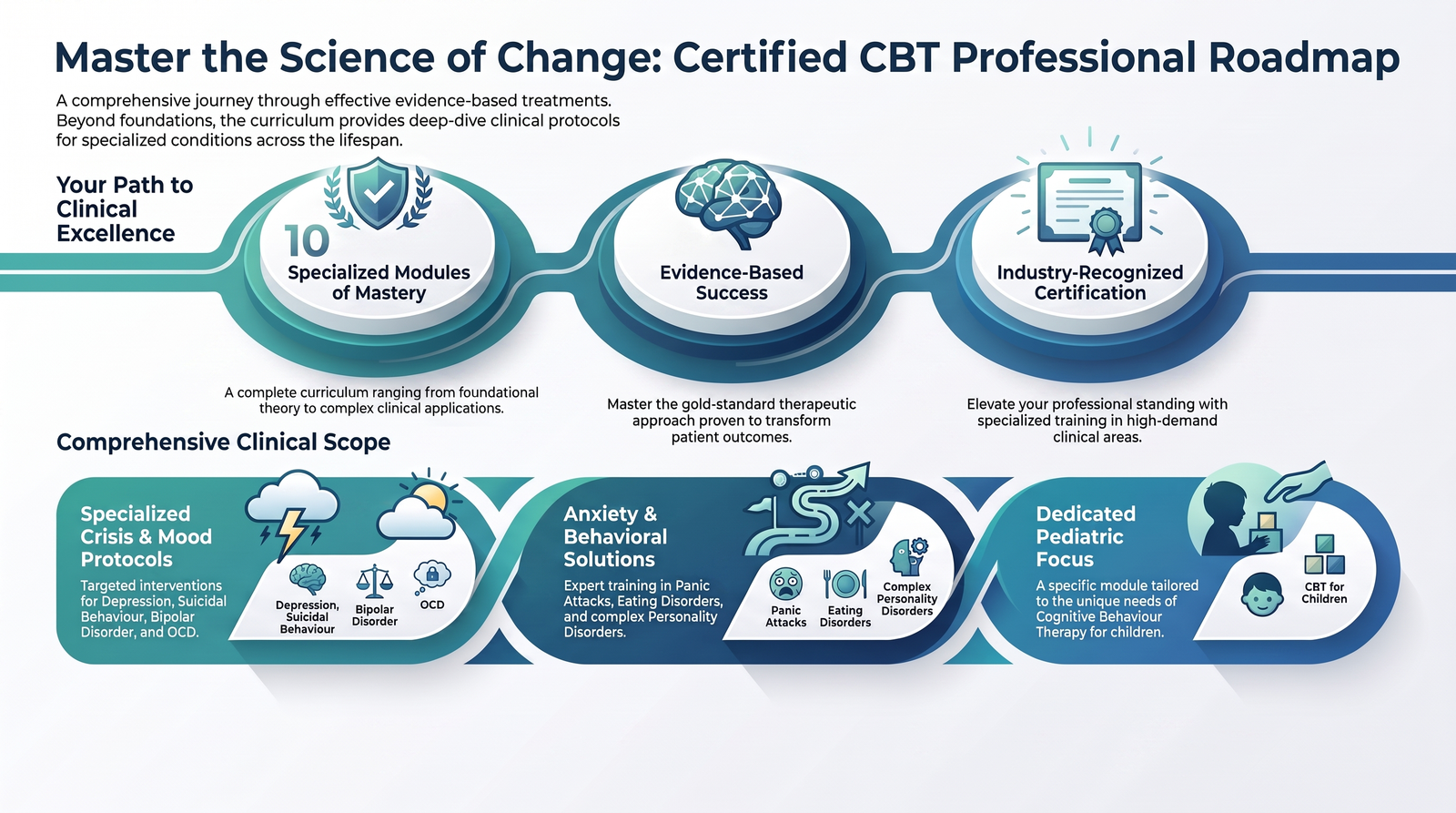
Certified Cognitive Behaviour Therapy (CBT)
Introduction:
1. The Strategic Value of CBT Mastery
Cognitive Behavioural Therapy (CBT) stands as the gold standard for evidence-based psychological intervention, providing a rigorous, empirical framework for mental health treatment. In a professional landscape where accountability and patient outcomes are under increasing scrutiny, achieving “Certified” status is a non-negotiable career milestone for the modern practitioner. This certification serves as a powerful risk-mitigation strategy, shifting the practitioner’s clinical profile from a reliance on anecdotal success to the certainty of empirical reliability.The “Certified Cognitive Behaviour Therapy” program is a transformative curriculum that moves practitioners beyond the passive acquisition of tools toward a disciplined, module-based mastery. By transitioning from isolated techniques to structured, cohesive clinical protocols, practitioners significantly enhance their clinical efficacy and diagnostic authority. This evolution ensures that the professional is not merely “practicing therapy” but is instead deploying validated interventions that provide a measurable return on investment for both the patient and the provider.This certification journey is meticulously structured to provide a comprehensive roadmap from foundational theory to the most complex clinical specializations.
2. Architecture of the Comprehensive Curriculum
A multi-disciplinary approach—bridging general principles with disorder-specific protocols—is essential for navigating the complex mental health landscapes practitioners face today. This curriculum is engineered to equip the strategist with the precision required to treat both common psychological distress and high-stakes clinical presentations with equal competence.
Curriculum Breakdown: The 10-Module Framework
The following modules represent the core pillars of the certification, each designed to close a specific gap in traditional clinical practice:
- Module 1: Cognitive Behavioural Therapy – Establishes the non-negotiable empirical framework and core methodologies required for clinical accountability.
- Module 2: Cognitive Behavioural Therapy for Depression – Provides the specialized methodology required to dismantle the cognitive triad of hopelessness and negative self-bias.
- Module 3: Cognitive Behaviour Therapy for Suicidal Behaviour – Navigates the highest clinical stakes through specialized, safety-focused protocols that prioritize immediate stabilization.
- Module 4: Cognitive Behavioural Therapy for Bipolar Disorder – Bridges the gap between standard CBT and the unique management requirements of pharmaceutical-integrated mood cycling.
- Module 5: Cognitive Behavioural Therapy for Panic Attack – Focuses on rapid de-escalation of acute physiological distress to restore patient autonomy and function.
- Module 6: Cognitive Behavioural Therapy for OCD – Disrupts the debilitating cycles of intrusive thoughts and ritualistic behaviors that standard talk therapy often fails to penetrate.
- Module 7: Cognitive Behavioural Therapy for Anxiety and Panic – Replaces chronic, maladaptive worry with systemic emotional regulation and evidence-based coping mechanisms.
- Module 8: Cognitive Behaviour Therapy for Personality Disorder – Eliminates clinical stagnation by deconstructing entrenched, long-term personality structures through intensive intervention.
- Module 9: Cognitive Behaviour Therapy for Eating Disorder – Targets the failure of traditional counseling by addressing the high-impact intersection of cognitive distortion and behavioral health patterns.
- Module 10: Cognitive Behaviour Therapy (CBT) for Children – Translates adult-centric models into developmentally appropriate early interventions for younger populations.
Comparative Scope: Core vs. Advanced Application
The curriculum is strategically balanced to ensure that foundational stability leads directly into high-impact clinical specializations.| Core Clinical Competencies | Advanced Specialty Protocols || —— | —— || Module 1: Foundational CBT Theory | Module 4: Bipolar Disorder || Module 2: Depression Protocols | Module 5 & 7: Panic and Generalized Anxiety || Module 3: High-Stakes Crisis Intervention | Module 6: Obsessive-Compulsive Disorder || | Module 8: Personality Disorder Management || | Module 9: Eating Disorder Treatment || | Module 10: Early Intervention (Children) || Strategic Outcome: Establishes a baseline of empirical reliability. | Strategic Outcome: Delivers a marketable clinical edge in complex cases. |
This broad foundation provides the clinical stability necessary to pivot into the specialized expertise required for the most demanding psychological challenges.
3. Deep-Dive into Clinical Specializations
General counseling skills are often insufficient when practitioners are confronted with severe or chronic conditions. Specialist protocols for Bipolar Disorder, Personality Disorders, and Suicidal Behaviour are critical for ensuring patient safety and promoting long-term recovery. These areas require a level of diagnostic nuance and intervention precision that separates a certified specialist from a general practitioner.
Analyzing High-Impact Specializations: The “So What?”
The inclusion of Modules 4, 6, and 8 provides a significant differentiator for the certified professional. Here is how this specialization alters your clinical practice:
- Management of Intrusive Cycles: Module 6 (OCD) equips the practitioner to manage the specific “thought-action fusion” and intrusive cycles that standard CBT often misses.
- Breaking Clinical Stagnation: Module 8 (Personality Disorder) allows the professional to navigate the “treatment-resistant” label by addressing the deep-seated cognitive structures that cause generalist interventions to stall.
- Complex Diagnostic Nuance: Module 4 (Bipolar) provides the specific tools to manage the shift between depressive and manic states, a level of precision that generalists lack.
The Psychological Spectrum Logic
The curriculum mirrors the comorbidity often seen in clinical practice. It begins by establishing a foundation in affect regulation through mood stabilization (Depression and Suicidal Behaviour) before tackling complex behavioral loops (Panic, OCD, and Eating Disorders). This progression ensures that the practitioner stabilizes the patient’s foundational mood before attempting to deconstruct complex, ingrained behaviors.While adult mastery forms the core of a practice, the strategic practitioner recognizes that clinical impact is greatest when applied at the point of developmental origin.
4. Expanding the Impact: CBT for the Next Generation
The inclusion of Module 10 (CBT for Children) is a strategic necessity for any modern therapeutic portfolio. As the demand for early intervention skyrockets, the ability to translate complex cognitive concepts into age-appropriate frameworks provides a distinct marketable clinical edge.
Early Intervention: The Lifespan Toolkit
Adapting core CBT principles for younger populations completes the practitioner’s toolkit across the human lifespan. By mastering child-specific CBT, you gain a comprehensive diagnostic authority that allows for intervention during formative years, potentially altering a client’s entire mental health trajectory. This transforms the practitioner into a holistic provider of mental health solutions rather than a niche adult counselor.
Final Value Proposition
The 10-module “Certified Cognitive Behaviour Therapy” journey represents a singular, high-value asset for professional development. It synthesizes foundational theory with high-impact clinical specializations and essential early intervention protocols to create the definitive roadmap for professional excellence.Claim your clinical edge and secure your diagnostic authority by mastering the gold standard of evidence-based psychological intervention.